


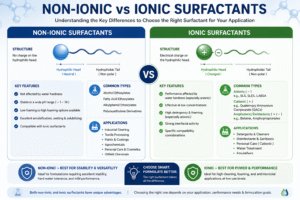
Non-Ionic vs Anionic Surfactants: What’s the Difference?
Surfactants are essential components in many industrial cleaners, detergents, emulsifiers, and specialty chemical formulations. But what is the difference between non-ionic and anionic surfactants, and which one is right for your application?
🧪 Non-Ionic Surfactants
Non-ionic surfactants do not carry an electrical charge in water. They are valued for their excellent wetting, emulsifying, dispersing, and cleaning properties.
They are commonly used when a formulation requires:
* Excellent emulsification and wetting
* Broad compatibility with other ingredients
* Lower sensitivity to water hardness
* Versatile performance across different applications
⚡ Anionic Surfactants
Anionic surfactants carry a negative electrical charge when dissolved in water. They are widely used for their strong detergency and foaming properties.
They are commonly selected for:
* Strong cleaning performance
* Effective removal of oils and dirt
* High foaming requirements
* Detergent and industrial cleaning formulations
⚖️ So, Which One Should You Choose?
The right surfactant depends on your specific formulation and application requirements.
Choose non-ionic surfactants when wetting, emulsification, and broad compatibility are important. Choose anionic surfactants when strong detergency and foaming performance are the priority.
In some formulations, both types can be used together to achieve the desired balance of cleaning, wetting, emulsification, and foaming performance.
✨ The right surfactant can make all the difference.
At Chemura, we supply specialty chemicals and chemical solutions for a wide range of industrial applications.
Looking for the right surfactant for your formulation? Contact Chemura to discuss your requirements.
